
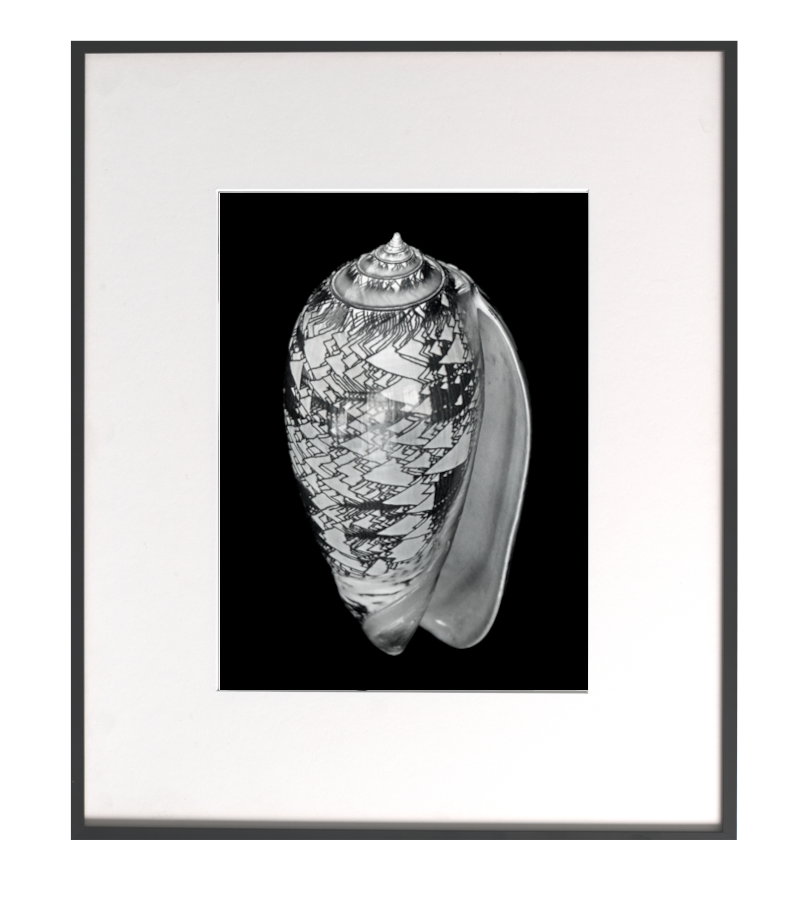

Nautilus – Muscheln und Schnecken, Fotografie von Alfred Ehrhardt

Shown on an APHEUM Frame · Frame sold separately.

© Alfred Ehrhardt Stiftung

Digital photo collection for APHEUM Frames

31 gelatin silver photographs by Alfred Ehrhardt from 1938 to 1941—shells and snails from oceans around the world, precisely lit and curated as a digital APHEUM collection.

Alfred Ehrhardt · Photographer

Nautilus – Shells and Snails in Photography · Alfred Ehrhardt

One-time price
Offer price€160,00

incl. VAT

31 works curated with context:12 Monate
31 photographs Automatic delivery Frame sold separately

Digital photo collection for APHEUM Frames

About the collection

“Nautilus – Shells and Snails in Photography” brings together 31 gelatin silver photographs by Alfred Ehrhardt from 1938 to 1941. Against deep black, the shells appear as sculptural architectures of nature.

Architectures of Nature

Conchylia fascinated Alfred Ehrhardt because in them an organic being produces an inorganic form. Conchylia are the hard calcareous shells secreted by mollusks during their lifetime and left behind after death. The shell is the result of every stage of the inhabitant’s development and, like the rings of a tree, records a substantial part of its life rhythm. No other modern photographer explored this subject as extensively as Alfred Ehrhardt. He devoted half his life to shells and snails alone.

Against deep black, Ehrhardt stages the shells like sculptures in empty space. The ground disappears and no reflection distracts the eye. Sharp, directed light models the surface—ridges, spines, mother-of-pearl sheen—and makes it almost tangible. The compositional rigor reveals an artist trained at the Bauhaus in Dessau; the dramatic chiaroscuro, a musically educated master of rhythm and counterpoint.

Ehrhardt’s photographs demonstrate photography’s singular ability to render the essence and character of things. They bring out the material nature of the conchylia and make smooth or rough, iridescent or matte, patterned or furrowed shell surfaces almost palpable. Photography raises the majestic form of the shell onto a pedestal so that it may be admired.

This collection brings together 31 gelatin silver photographs made between 1938 and 1941 at the Zoological Museum in Hamburg. From the legendary wentletrap shell and the nautilus to a sectioned Strombus shell, it includes specimens from oceans around the world—the South Pacific, the Indian Ocean, the Philippines, the Mediterranean and the Strait of Magellan—and reveals the breathtaking variety of form in these ancient architectures of nature.

Conchylia have always fascinated humankind as some of nature’s most enduring and aesthetically astonishing remains. They have been a constant and irresistible subject for artists around the world. No field of fine or decorative art has failed to engage with shells and snails: Renaissance and Mannerist goldsmiths, for example, were inspired by their fantastical forms to create vessels and ceremonial cups.

Scope
31 photographs
Access period
12 Monate
Delivery
digital and automatic
Use
private use on APHEUM Frames
Included
Digital collection; frame and print not included

The complete collection: Nautilus – Shells and Snails in Photography

The previews are protected.

🛑
Access blocked

Developer tools were detected. Please close the console and reload the page.

Artists

Alfred Ehrhardt
© Alfred Ehrhardt Stiftung
Alfred Ehrhardt
Photographer
More about Alfred Ehrhardt+

Alfred Ehrhardt (1901, Triptis – 1984, Hamburg) is regarded as an outstanding representative of German avant-garde photography for his abstract studies of nature. Ehrhardt was a musician, painter and art educator trained at the Bauhaus in Dessau. In 1933, the National Socialists dismissed him from the Hamburg State Art School because of his modern view of art; he subsequently became a photographer and filmmaker.

In photographic series such as The Wadden Sea, Curonian Spit, Crystals, and Shells and Snails, Ehrhardt combined tendencies of New Objectivity and New Vision photography. The compositional precision of his images reveals his artistic training. Influenced by Ernst Haeckel’s Art Forms in Nature, Karl Blossfeldt’s Art Forms in Nature and Albert Renger-Patzsch’s The World Is Beautiful, he found in natural forms an artistic language of singular consistency.

Following Klee, who defined the study of nature as the starting point of artistic creation, Ehrhardt sought to depict the “elemental forces” of nature and the “absolute laws of all phenomena” in his photographs of natural subjects. He wanted to convey that human beings are only part of an “overwhelming, timeless” nature. It is no coincidence that he was called the “natural philosopher with a camera.”

Like many of his contemporaries, Ehrhardt was influenced by Goethe. He knew that Goethe collected not only stones but also shells. Goethe described his shells as “fetish-like sanctuaries” and recognized in the spiral a principle he extended from plants to all living beings: the interaction of the vertical, fixed axis with the spiral winding upward around it—the “vital incurvation as the fundamental tendency of life.”

With more than 20 photobooks to his name, Ehrhardt ranks among the most successful photographers of the former Bauhaus artists. He is considered the “most important German creator of post-war cultural films” and received numerous national and international awards for his more than 50 films, including four German Film Awards. The film Play of Spirals (1951), which earned him his second German Film Award, together with Dance of the Shells (1956) and Corals—Sculptures of the Seas (1964), belongs to his most formally powerful and experimental works.

In 2002, his son Jens Ehrhardt founded the Alfred Ehrhardt Stiftung in Berlin, which keeps his work alive through exhibitions and publications. In October 2025, the foundation stone was laid for the Ehrhardt Museum in Plüschow, Mecklenburg-Western Pomerania, designed by Pritzker Prize winner Francis Kéré.

Source

How it works

1
Unlock the collection
2
The collection is automatically assigned to your APHEUM account
3
Choose works and experience them on your APHEUM Frame

Terms of use & licence

What is included in the one-time price?+
You unlock the complete digital collection for the purchased access period. No physical print or APHEUM Frame is included.
What happens when the access period ends?+
Access ends after the purchased period. It does not renew automatically and you will not be charged again.
How may I use the collection?+
For the contract term, you receive a non-exclusive right of use for private and non-commercial display on APHEUM Frames. Private use is permitted worldwide. Sharing the content or creating copies for third parties is not permitted.