

More about Yevgeny Khaldei+
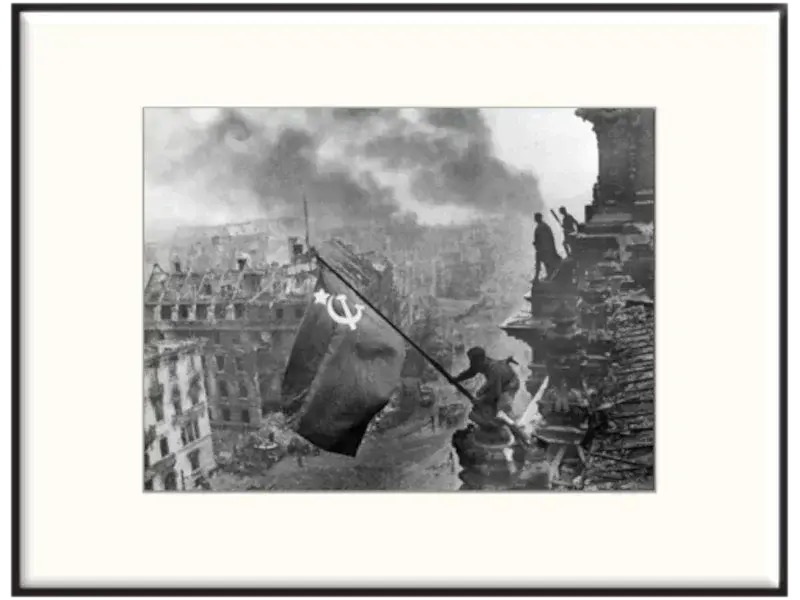
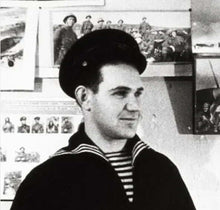
J. Khaldei is one of the most important war photographers of World War II. His American counterpart is the famous Robert Capa. The two met at the Nuremberg Trials and became friends.
Robert Capa even gave J. Chaldej his large-format camera, a Speed Graphics, so that J. Chaldej could work more effectively. Later, J. Chaldej returned the favor by developing R. Capa's films when he and John Steinbeck traveled to the Soviet Union as the first Western journalists after the war. There was also an important personal connection that ran like a thread through their lives. R. Capa comes from a Jewish family of tailors.
J. Khaldei was born in Donetsk, Ukraine, and is also of Jewish descent. Read more in his biography.
J. Khaldei had a much harder time than R. Capa and his other American colleagues. He worked under one of the most terrible dictatorships in history. J. Khaldei's scope and freedom under Stalinism were very limited.
Today we know that he used them to the fullest extent possible and didn't shy away from risking his life. Ernst Volland and Heinz Krimmer found a war diary in his estate. Writing such a diary was forbidden under penalty of death for Soviet soldiers during World War II. There was no exception for journalists.
And there was another key difference. Soviet soldiers didn't have to pull out all the stops to be deployed directly to the front lines. They were assigned to do so because they were soldiers first and photographers second. The death toll of Soviet war photographers is long. That Y. Khaldei survived the entire war is nothing short of a miracle.
And there was another major problem: the lack of material.
When Y. Khaldei was first sent to the front in Murmansk, he was given just 100 meters of film to last for several months. Considering the task at hand, this was a downright ridiculous amount. Y. Khaldei made the most of it.
.
Vita+
March 10, 1917
Khaldei was born in Yusovka, later Stalino, today Donetsk (Ukraine)
born to a Jewish family.
1918
The mother is murdered during a pogrom, Chaldej is seriously
injured.
J. Chaldej on the incident:“Pogroms still exist today, although
Stalin no longer exists. Under Brezhnev and Khrushchev there was also
Pogroms, again and again. In your passport is the mark of Cain that you are a Jew—the
is it."
1925-1929
School years. The twelve-year-old builds his first camera.
“I took the first photos with a self-made camera
There were no themes as such, I photographed the church, the streets
-all immovable things, I was neither a professional photographer nor did I have a
good chamber; I was twelve years old."
1930-1936
Worker in a steel mill in Donetsk. He published at the age of 15
years his first
Photo (portrait of a top worker)
“I photographed Soviet heroes, workers who
achieved production records, farmers, all this propaganda material. At that time
no one considered that propaganda."
During a trip through the Stalino area in 1932
As a photographer he accompanied an agitation brigade and was confronted with the mass
faced starvation as a result of forced collectivization.
1936
After working for regional newspapers, Chaldej was sent to
Moscow to attend a course run by the Soyuz Photo Agency. Move from Yusovka to
Moscow.
“I lived in a communal apartment together with eight families,
and in seven of these people disappeared without a trace could have happened to me too
We grew up in an atmosphere where everyone was everyone else's enemy,
and we did not know what had been done to them, only that they
disappeared."
1936-1948
Photo correspondent for the TASS news agency.
1941 – 1945
Official war photographer in the Red Army.
"I felt it was necessary. I was also a soldier. I
was in Murmansk, on the Black Sea, in Novorossisk, with the troops in Kerch
in the Crimea, later near Sevastopol. Sevastopol was liberated on May 9, 1944,
a year before the victory. But we did not know at that time that on May 9, 1945
the victory should be celebrated."
Probably 1943
receives Khaldei due to
his merits, he was promoted to the rank of lieutenant (Navy). From 1944
As a photographer he accompanied the advance of the 3rd Ukrainian Front and was
the conquests of Sofia, Bucharest, Budapest, Belgrade and Vienna.
"I always worked alone, nothing could distract me. Everything,
What I had was my black leather coat, a uniform cap, little
Clothes and chemicals for film development in my backpack. I found
always something to eat and always a place to sleep, mostly in cellars or
destroyed houses."
End of April 1945
he is sent to Berlin to ensure the victory over fascism
to document.
1941 or 1942
Chaldej's father and his sisters Etia, Zilia and Riwa belong
to the two million Soviet Jews who were killed by the German troops
were murdered.
“They were not shot, but buried alive in coal mines
thrown together with 75,000 people! That was in 1941/42. That was when I saw the
Germans very much hated. Unfortunately, I later learned that many Russians
helped a lot with this."
1945
Official Soviet photographer during the Potsdam Conference
(TASS).
1945
Marries Svetlana.
1946
Official Soviet photographer during the Nuremberg Trials
(TASS).
1947
Birth of daughter Anna.
1948
Khaldei is accused of alleged unprofessionalism by TASS
dismissed.
“Immediately after the Potsdam Conference I went to the Far East,
to China, in August to Nuremberg, then to Paris. When I became a civilian again
was, the photo chronicle TASS dismissed me on the grounds that there was no work
more for me. The real reason was that I'm Jewish."
1948-1951
Makes a living with odd jobs.
1951 - 1956
Photographed for various smaller newspapers and magazines.
1956
Birth of son Leonid.
1956-1971
Photographer at Pravda.
“Then I started working for the Friendship Society Abroad and
I joined Pravda in 1956. I stayed there for fifteen years. On behalf of Pravda
I traveled throughout the Soviet Union."
From 1971
Photographer at the Soviet Cultural Center.
"I was still taking photographs until the Gorbachev era. Gorbachev
was the last one I photographed. I am interested in photography
I still do, but not in the events. I used to read all the interesting
I photographed events, I had an interest in people and
events."
1994
First exhibition in the West at the Kunstamt Neukölln, Berlin, Gallery
Körnerpark, Ernst Volland and Heinz Krimmer Collection. Also the first book in
West:“From Moscow to Berlin”,Edited by Ernst Volland and Heinz Krimmer.
1997
On October 6, Khaldei died in Moscow.
Quotes from:“From Moscow to Berlin”,published by
Ernst Volland and Heinz Krimmer, pp. 121-125 and Brian Moynahan,"Witness of
History“,The Time Magazine September 17, 1994, p.2881.