

More about Karl-Heinz Mai+
When Detlef Mai was working through his father's estate, he found a dedication addressed to him in one of the many photo diaries in Album 3:
“To my son Detlef, so that he can see for himself the senselessness of war and learn from it to preserve human values instead of destroying them!”
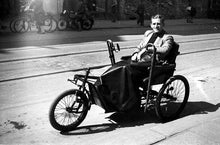
Karl Heinz Mai knew what he was talking about. Born in 1920, he belonged to the generation that bore the brunt of the Second World War. In 1939, at just 19 years old, he was drafted into military service. In 1941, he was severely wounded and lost both legs. From then on, he could only move around in a wheelchair, a so-called "self-propelled" wheelchair powered by muscle power. It is a testament to his personal strength and willpower that, despite enormous limitations—the loss of his parents' home in the worst bombing raid on Leipzig and the disruption of his professional development—he asserted himself, made the best of his fate, and devoted himself to photography.
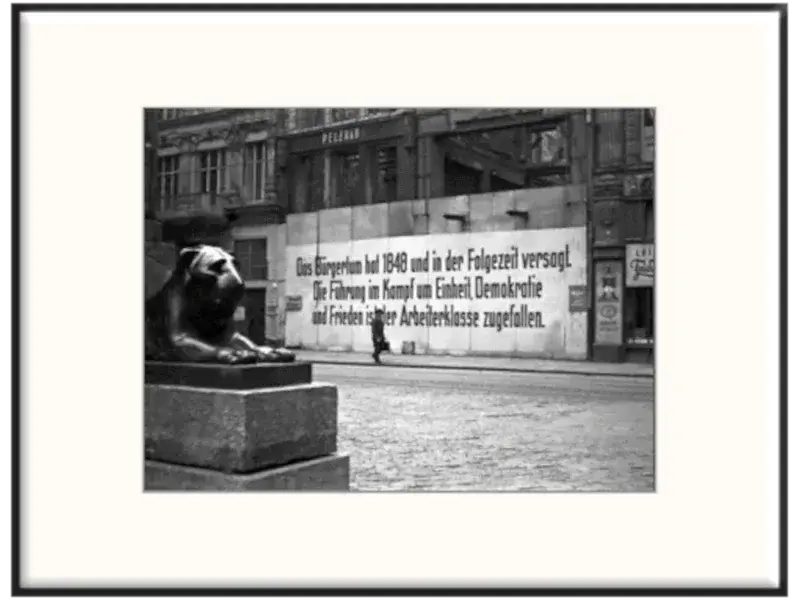
Some of the publications currently in existence refer to this fate. Photo historian Dr. Diethard Kerbs, one of the first to recognize the significance of Karl Heinz Mai's work, published photographs from Leipzig from 1945 to 1950 under the title "Anfangsjahre" (Early Years) in his highly acclaimed Fototaschen book series published by Dirk Nissen Verlag, Berlin, in 1985. The first illustrated book, "Reporter des Alltags" (Everyday Reporter), was published by Pro Leipzig in 2012 by his grandson, Andreas Mai, with a foreword by Bernd-Lutz Lange. The most recent book, published in 2019 by Lehmstedt Verlag on the occasion of the photographer's 100th birthday, references his "self-driver": "Reporter auf drei Rädern" (Reporter on Three Wheels).
His paintings have been shown in over 300 exhibitions, and his photographs are featured in nearly 200 books. A 30-minute documentary film was shown in the ARD media library for three years, as his photographs have also been used in film and television.
In this self-driver he also met most of his
Know the people portrayed. Children, women clearing rubble, families, couples, professionals,
Homeless people and old people. And today we too can see his
war-related restrictions. He could only see one perspective
That of a sitter. All the more important is the realization that this is the
quality of his pictures in no way impaired, but unconsciously led to
became his trademark.
Karl Heinz Mai died much too early in 1964. The war injury is considered the cause of his death at just 44 years of age.
Vita+
Born on February 28, 1920 in Leipzig
1926-1934 Elementary School
1934-1937 Vocational School
September 1939
Kirchner & Co. Leipzig,
Merchant's assistant
January 1940 military service
August 1941 wounded
until summer 1943 hospital
Summer 1943 Return to parental home
December 4, 1943
Apartment lost in bomb attack
1943-1945 Asylum in the Niederwiesa rectory
Summer 1945 Return to Leipzig
1945-1949 Lives in his parents' house in Leipzig-Gohlis
1945-1955 "Mobile" photographer in Leipzig
and surroundings
1945-1955 Documentation of everyday life and
Construction in Leipzig
1949 Wedding, birth of son
1954-1964 Photos for museums, archives, newspapers,
Book participations
1949-1964 Family lives in Leipzig-Möckern
09.05.1964 During a weekend stay in Reinharz
deceased